

How Sleep Cycles Work: An Easy 5-Part Guide
Sleep cycles shape how rested you feel each morning, even if you don’t notice them happening. Some mornings you open your eyes and everything clicks. Other mornings it feels like your body rebooted halfway and forgot to load the important programs.
Most people chalk that difference up to stress, “not being a morning person,” or whatever horoscope they were born under. But usually, it’s none of that. It’s timing. Specifically, where you were inside a sleep cycle when you woke up.
Sleep isn’t one long drift into nothingness. It’s a pattern. A rhythm. And if you understand the rhythm, you can work with it instead of waking up feeling like you’ve been chewed on by the night.
This isn’t a deep science explainer. It’s just the part that actually helps you get through your day without wondering why your brain is lagging three seconds behind your body.
How Sleep Cycles Work
A sleep cycle is a loop your brain runs every night. Inside each loop, your body does different work. That’s really all you need to know. Everything else is just understanding the timing and learning how not to interrupt yourself in the middle of the wrong stage.
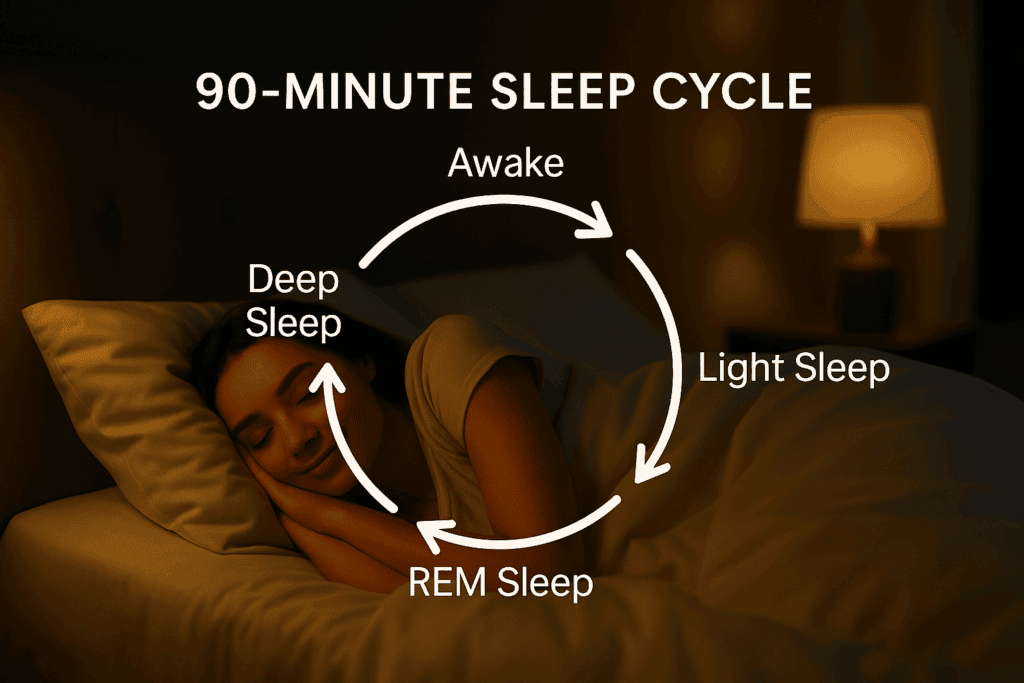
What a Sleep Cycle Is, Without the Lab Coat
Sleep cycles last about 90 minutes. Inside those 90 minutes, your brain moves through:
- Light sleep (the glide path)
- Deep sleep (the repair shop)
- REM sleep (the mental dishwasher)
Then it starts over. You repeat this 4–6 times a night depending on how much sleep you actually give yourself.
It’s predictable the way ocean tides are predictable—not clockwork perfect, but close enough to work with.
Inside the 90-Minute Loop
Light Sleep: The Ramp Down
Your body slows. Your brain loosens its grip. You’re still easy to wake. Light sleep is your on-ramp—nothing dramatic, just enough to get you from “awake” to “shut down.”
Deep Sleep: The Heavy Lifting
This is when your body steps away from the customer-facing responsibilities and heads into the back to fix the plumbing.
Muscles repair.
Your immune system recalibrates.
Your brain waves drop into low gear.
Waking up from deep sleep feels like surfacing from wet cement.
REM Sleep: The Quiet Chaos
Dreams happen here—sometimes surreal, sometimes boring, sometimes disturbingly on-the-nose.
REM isn’t about rest. It’s about mental cleanup. Your brain sorts memories, files feelings, and does emotional housekeeping you don’t need to supervise.
The Night Has a Pattern Whether You Notice or Not
Your night has a structure:
- Early cycles: more deep sleep
- Late cycles: more REM
Early night is physical repair.
Late night is mental repair.
Cutting the night short usually means cutting off the part that helps you feel emotionally level. When sleep cycles are interrupted, you wake up groggy and discombobulated.
Where Things Go Sideways
People misunderstand sleep in predictable ways:
1. “If I wake up at night, something’s wrong.”
No. Most people wake up briefly between cycles and never remember it.
2. “I can force myself into deep sleep.”
You can’t. Your brain’s running the show here.
3. “Everyone sleeps the same way.”
Kids, adults, older adults—every group cycles differently.
4. “More hours always means better sleep.”
Quantity without quality usually backfires.
What Actually Helps (Quick and Real)
Keep the same wake-up time.
This anchors everything. Your body likes rhythm.
Give yourself enough time for 4–6 cycles.
More cycles = less grogginess.
Cut the stimulation before bed.
Screens, caffeine, work—it all keeps your engine idling.
Make your room sleep-friendly.
Cool, dark, quiet. Cave, not electronics showroom.
Have a small ritual.
Something simple that tells your brain the day is done.
These aren’t “sleep hacks.” They’re maintenance.
Helpful Habits to Build
- Keep wake-up times steady
- Use calming, low-light activities before bed
- Avoid heavy meals or caffeine late
- Give your body enough runway to complete cycles
None of this requires perfection. Just consistency.
When It Might Be Something Else
Noise, light, stress, heat—any of these can interrupt cycles. But if you’re:
- waking up gasping
- feeling exhausted after full nights
- lying awake for weeks
- getting jolted out of sleep with leg discomfort
…it might be worth mentioning to someone who handles the medical side. Not everything is a habit problem.
Related Guides
If you want to go deeper:
- The 4 Sleep Stages Explained — a simple breakdown of each stage and why it matters.
- Causes of Poor Sleep — the everyday things that quietly wreck your nights.
- How to Improve Sleep Quality at Home — practical changes you can make tonight.
These build on the same idea: your sleep follows a pattern, and once you understand that pattern, things get easier.
FAQs (The Human Version)
How many cycles do I need?
Most people feel good with 4–6 sleep cycles, which usually means 7–9 hours of sleep.
Does waking at night ruin sleep?
Not usually. Brief wake-ups between cycles are normal.
Do I need to plan my sleep in 90-minute chunks?
Not strictly. It’s just a helpful way to understand the rhythm.
How do I know if my sleep cycles are getting interrupted?
If you regularly wake up foggy or slow—even after a full night—your cycles might be getting cut short.
Conclusion
You don’t need to micromanage your sleep. You just need to give your body enough time and a steady rhythm. Sleep cycles are automatic. They’ve been running long before any of us started tracking anything.
Support the system a little, and it pays you back in softer mornings, clearer thinking, and fewer days spent running on fumes.